Is China Ready for War?
Coast Guard deaths lay bare the regime’s insecurity

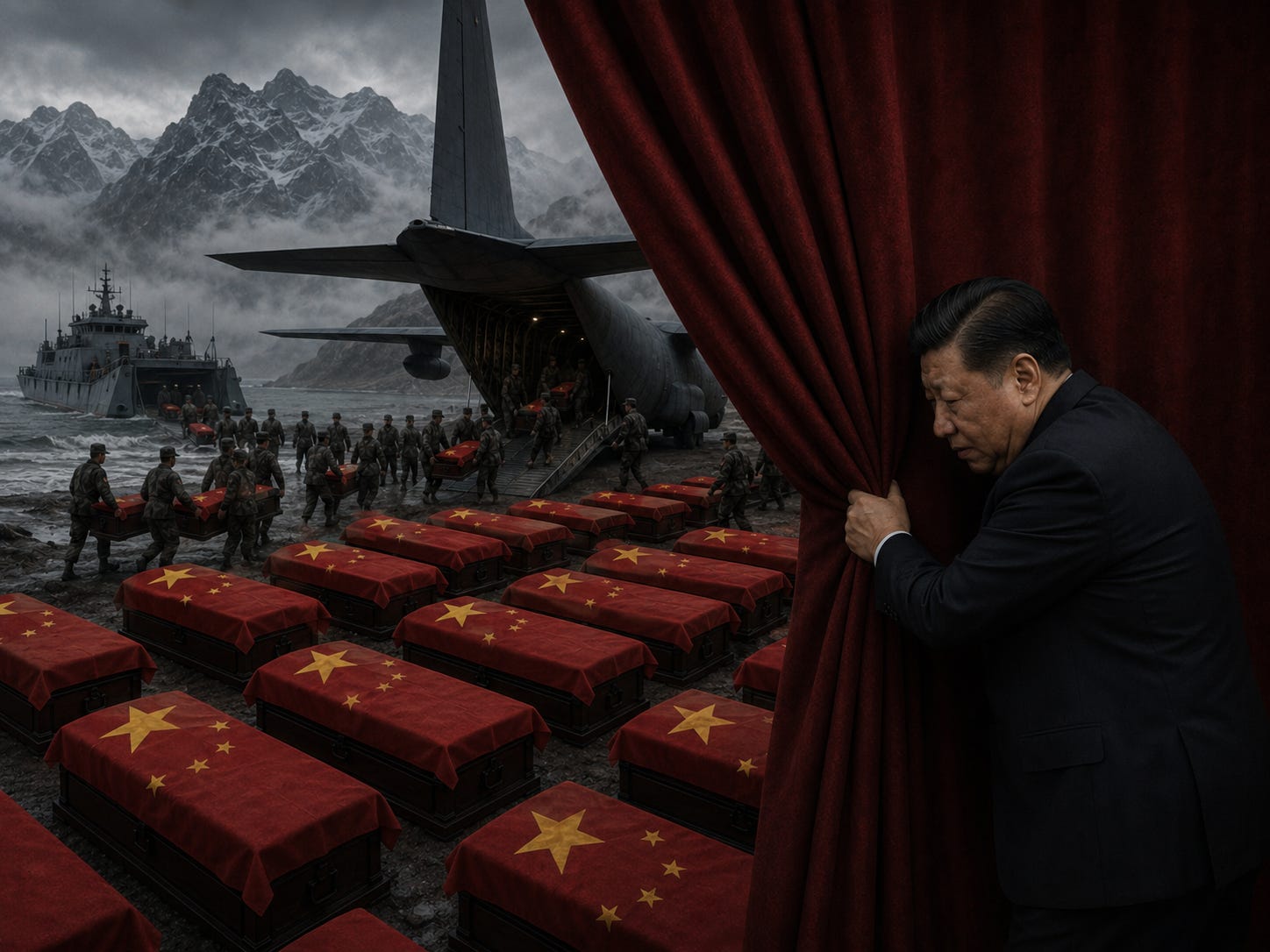
This week in Taiwan, as the country undergoes its largest annual military exercises, involving air, sea, and land drills and calling up thousands of reservists, the international media are asking again and again: are the Taiwanese ready for war? Polls consistently suggest a clear majority of Taiwanese are willing to fight, yet the midnight debates in Taipei (and in Washington) endlessly interrogate the size of the gap between what many young Taiwanese men will say on the phone compared with how many will actually show up on the brink of war to defend their shores and likely die for their nation.
It’s an important question. I think the Taiwanese will be more likely than not to defend their homeland. But perhaps more intriguing is whether China is ready to send tens of thousands of single sons to their deaths for so-called national unity.
I’m not entirely convinced.
Earlier this week, China officially confirmed that two Coast Guard personnel were “martyred” in a high-profile incident last year when a Chinese Coast Guard cutter crashed into a Chinese Navy destroyer while harassing a Philippine Coast Guard ship in the disputed waters surrounding the Scarborough Shoal in the South China Sea/West Philippine Sea.
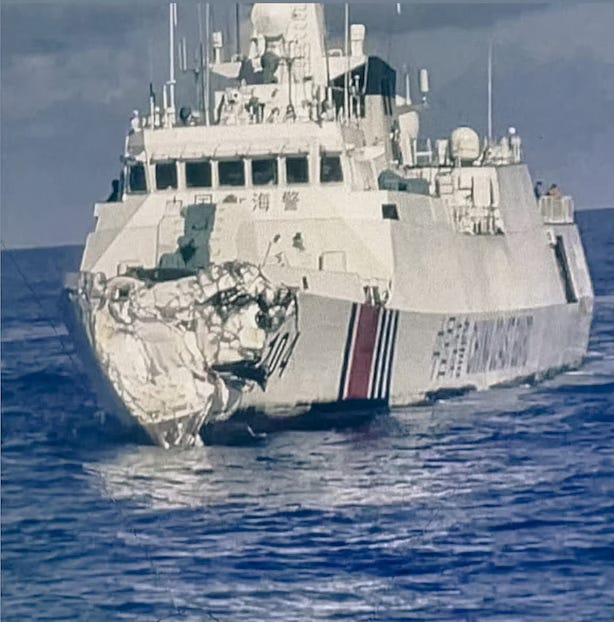
The Scarborough Shoal is illegally occupied by China yet claimed by the Philippines, which is far closer to the atoll than China is. An international tribunal ruled in 2016 that China’s claims of sovereignty were without effect, and affirmed the rights of both countries’ fishermen to access traditional waters. China’s response has been to chase away Filipino fishermen with violence and illegally restrict their access, prompting the Philippines Coast Guard to patrol in protection of its fishermen.
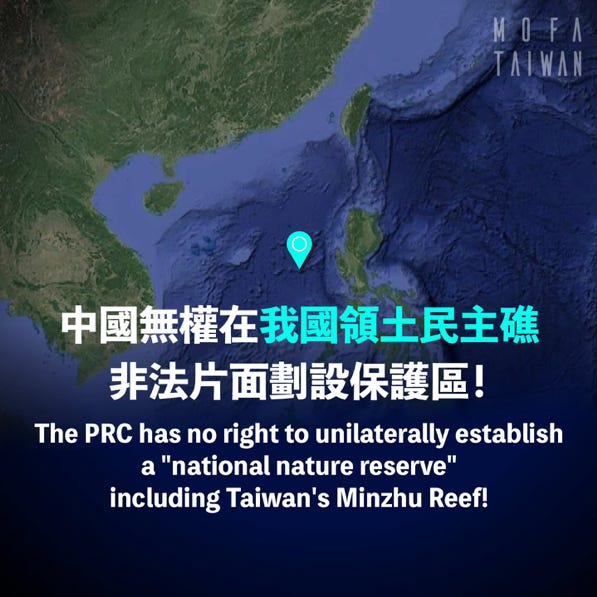
Taiwan’s response has mysteriously been not to support an allied democracy, its third most important military ally, the Philippines, against China’s expansion, but to instead side with China, with the DPP government incongruously resurrecting ROC claims to the entire South China Sea to claim incorrectly that the Scarborough Shoal belongs to Taiwan. Taiwan’s Foreign Ministry reiterated the absurd claim this week, without a clear explanation as to why it feels a strong need to speak out on this issue while also happy to ignore the ROC’s claim to Mongolia or the Senkaku Islands.
The Philippines had previously asserted in the days following the August 2025 incident that two Chinese Coast Guardsmen had been killed in the collision. China refused to confirm any casualties, and aggressively censored any discussion on the Chinese internet speculating that Chinese personnel may have died in the incident.
It took nearly exactly a full year for Chinese authorities to publicly acknowledge the deaths of the two young men, and even as their official citations with the Ministry of Veterans’ Affairs list them as “martyrs” who died “heroically,” there remains no official statement or official commemoration of their deaths. Chatter is rising on the Chinese internet, but the government has yet to explain to its people why these young men died a thousand kilometers from their homeland, or even publicly commemorate their sacrifice for the nation.
The delay comes as no surprise. China has long struggled to deal with the fatal fallout of its modern border skirmishes with its neighbors. The episode almost exactly parallels a much more violent incident in 2020 when Indian and Chinese forces skirmished for months along the two countries’ undemarcated Himalayan frontier. Restrained by the threat of nuclear escalation, the two armies have long resorted to hand-to-hand combat in the hundreds of standoffs and skirmishes that have broken out in the years following the 1962 Indo-Chinese war.
Yet in June of 2020 the two sides met with sticks, clubs, and bare fists resulting in the first fatalities on the border in decades. Facing off on high-altitude rocky terrain, some soldiers were reportedly shoved to their deaths off the sheer rock face, others bludgeoned by clubs, rocks, and iron rods. India immediately acknowledged that 20 of its own soldiers had been killed, and claimed a similar number of Chinese troops had been killed in the most intense combat on June 15.
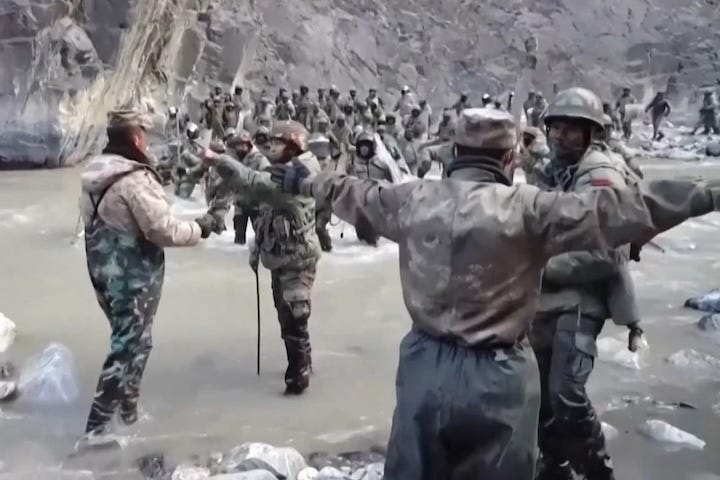
China had no idea how to respond. Refusing to confirm any deaths had occurred, discussion of potential Chinese fatalities was censored on Chinese media and military families were reportedly barred from properly burying or cremating soldiers’ remains, in direct violation of State Council Decree No. 601 on Regulations on Commendation of Martyrs.
It was not until eight months later, in February of the following year, that China acknowledged that four soldiers had died in the clashes, with no explanation for the eight month delay or the discrepancy with much larger figures reported by Indian and foreign media, which claimed 20-30 Chinese soldiers had died.
Despite the elegizing of the fallen as heroes defending sacred territory, what followed was an intense crackdown on discussion of the casualties online, with at least six prosecutions for questioning the official tallies or otherwise questioning the official narrative. It is also claimed that Chinese authorities even sought to arrest a 19-year old US permanent resident for online comments, pressuring UAE authorities to detain him in Dubai while in transit from Istanbul to New York. While the dissident, Wang Jingyu, was later freed, he came to notoriety in later years for orchestrating a massive global fraud scheme, and Dubai authorities claim his detention was over unpaid hotel bills and “criticizing Islam.”
Memento Mori
It is almost unheard of for a country to wait a year before acknowledging troops have been killed, particularly when it is so openly acknowledged by the other side, or recorded on film, as both the Galwan and Scarborough incidents were.
In the United States, it has already become a minor scandal that the Defense Department was covering up the number of war dead in the ongoing war with Iran, with public pressure so immense that the Pentagon reversed course within a few days. The US is a country that has long been at war, and long too accustomed to needlessly sacrificing its youth overseas in foreign wars. Yet the commemoration of war dead remains solemn, particularly following the Vietnam War, and US presidents are expected to preside over in-person the repatriation of fallen service members.
This somber commemoration of American war dead is part of what enables the US to continue to wage foreign wars, a tacit agreement that honors sacrifice and bestows immense benefits on veterans in exchange for a state that is continuously at war. Gold star families are considered national heroes, and fallen soldiers are immediately memorialized in news broadcasts and public commemoration.
India similarly has long been at war and has a deep public reverence for fallen soldiers and national memorialization. It reported its war dead within hours of the Galwan clashes, and while there are disputes over the governments’ actions during the standoff, casualty numbers are not suppressed nor is discussion of war losses. India, like the US, is long accustomed to the national reckoning of dealing with the human cost of war, having fought numerous border wars with its neighbors, as well as contending with major internal security and terror issues.
A fundamental difference is that India’s war dead perish on or within its own borders, whereas American soldiers perish in distant conflicts overseas, often in countries Americans cannot find on a map. The result is that the American political and media establishment invest a great deal into justifying foreign wars, even when they are very clearly not in American interests, because the backlash to Americans dying senselessly overseas is so furious.
China finds itself somewhere in between the two countries- its military engagements are within its claimed borders, yet often quite far away from China. While China’s ultranationalist population readily accepts and defends aggressive claims to foreign lands in India, the Philippines, or Taiwan, whether they are actually ready to accept as the cost of irredentism the lives of their single sons is a far more complex question.
The dovish US-China Perception Monitor (The Monitor on Substack) claims that a small majority of Chinese oppose the use of force to taken Taiwan. The number intuitively feels incorrect, given the near universal support in China for the fiction that Taiwan is part of their nation, and the ability of the government to unleash the drumbeats of war and nationalism when it needs to. It likely reflects that a majority of Chinese would certainly prefer to take Taiwan peacefully, which is in line with the official government stance, claiming to want peaceful so-called “unification” while openly threatening to use military force.
Yet for all its bellicose rhetoric and dangerous posturing in the air and seas around Taiwan, a gap clearly remains between the rhetoric of war and the reality of sending tens of thousands of Chinese sons home in body bags. The incidents in Scarborough and Galwan make that abundantly clear: if it cannot handle two or even a dozen deaths on the high mountains or high seas, even on territory it claims to be Chinese, China is not remotely prepared to handle the tens or hundreds of thousands of deaths of a war to conquer Taiwan.
Vietnam Syndrome
China has yet to heal its own scars from Vietnam. Veterans of that ill-fated war are as forgotten as the war itself. Amputees, banished from the swanky streets of Shanghai and Shenzhen, are by no means rare to see in the streets of China’s less fortunate regional capitals and smaller cities. Many are certainly victims of untreated diabetes (despite China’s supposed universal healthcare), but no small number are casualties of China’s failed 1979 invasion of Vietnam, considerably more remain hidden at home by their families.
Veterans of the forgotten war have been a persistent thorn in Beijing’s side, organizing mass protests in the past decades over grievances of being abandoned by the state after serving in Vietnam, left jobless and penniless. China’s response has been cautious, clamping down on protests while also attempting to placate their demands.
The Chinese Communist Party values stability, as most regimes do, and it will think long and hard before making any decision that threatens to wrest control of the country from the Party that has ruled it for eight decades. Losing a war with Taiwan would certainly be an existential event for the Party, but so too might be the outcome of any significant armed conflict.
Immediately following the August 2025 collision, I spoke to the South China Morning Post about its implications:
Sasha Chhabra, a research fellow at the Institute for National Defence and Security Research in Taipei, said “the inability of the [navy and coastguard] to coordinate just two ships not even under fire” raised questions about the navy’s abilities to carry out “a complex operation such as an amphibious attack or even blockade of Taiwan”.
My comments pointed out the logistical mountains ahead for China’s ability to mount an amphibious attack, but obstacles of human mortality may prove to be mountains even higher than the Himalayas.
The CCP’s attitude towards military deaths betrays a deep insecurity towards the human cost of an aggressive foreign policy. A country that waits a year to admit two soldiers died in a “righteous mission” is not a country that is ready to send tens of thousands to certain death.
Let’s hope it stays that way.
Proportion of single-son families is not the only relevant factor -- there is also risk of US intervention and attitudes toward casualties, as you point out -- but it is important to consider. This thinking naturally tends toward contrasting China with Russia, which has sent millions to the front since 2022 without successful domestic revolt or reform of war policy.
Yet it seems on the single son families question, the two states are not actually much different. Proportion of families with children who have only 1 child, and that child is a son: 24.2% China, 23.6% Russia. Proportion with only 1 son, regardless of daughters: 49% China, 48.2% Russia. (Usual caveats w/ using Claude.) TFR can be necessary but not sufficient for war hesitancy; the interests at stake, national politics, and other factors seem essential for explaining such an attitude.
Minor issues, in the national military museum in Beijing there is footage of the full military burial of the Galwaan casualties on display