Sunlight is Sovereignty
Taiwan needs more time. Literally.

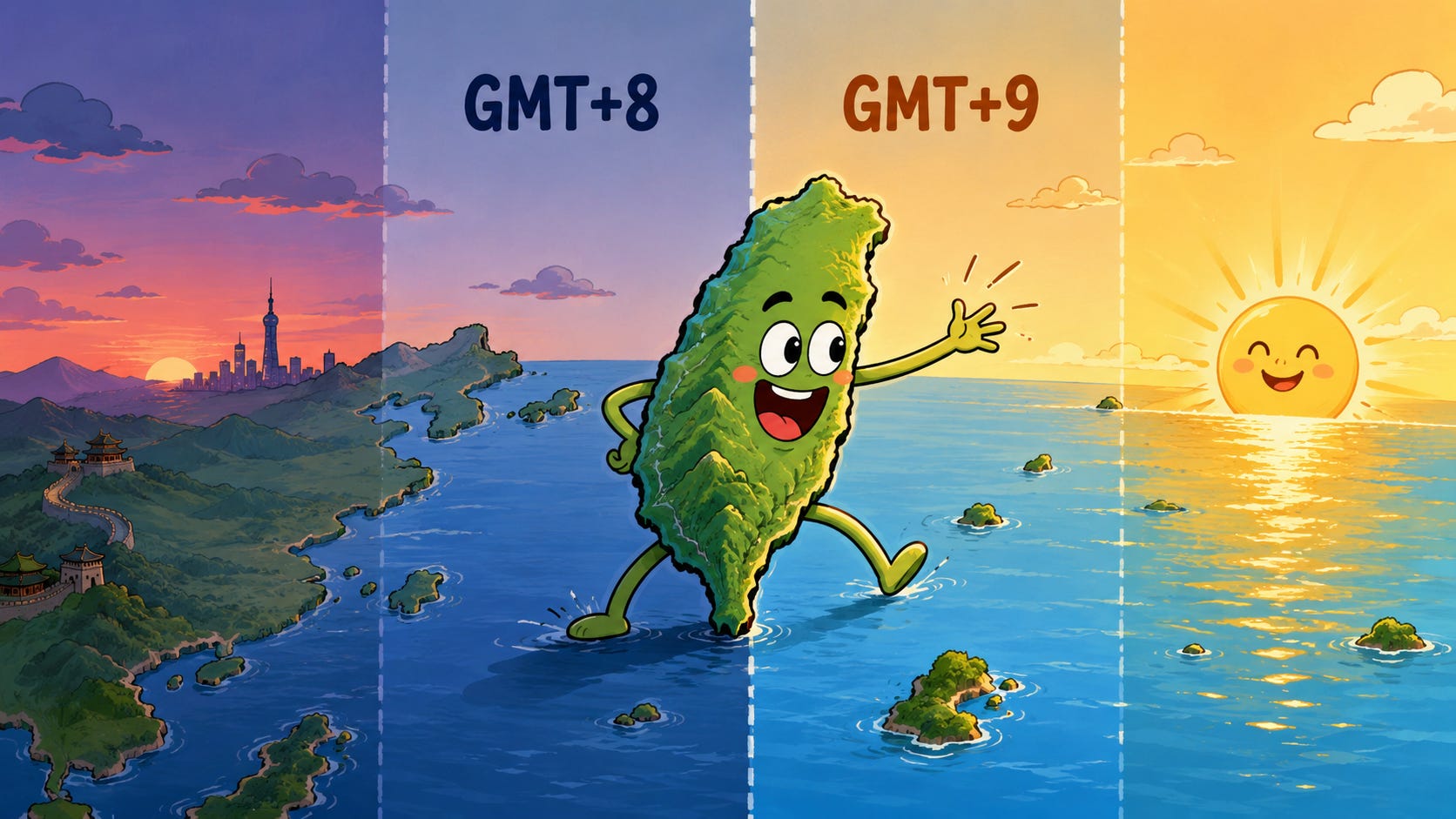
Taiwan needs more time. It needs more time to implement military reforms, more time to jumpstart domestic drone production, more time to train reservists, more time to import foreign military hardware, more time to escape its fertility cliff, and more time to transition away from fossil fuels.
But most immediately, Taiwan needs more sunlight.
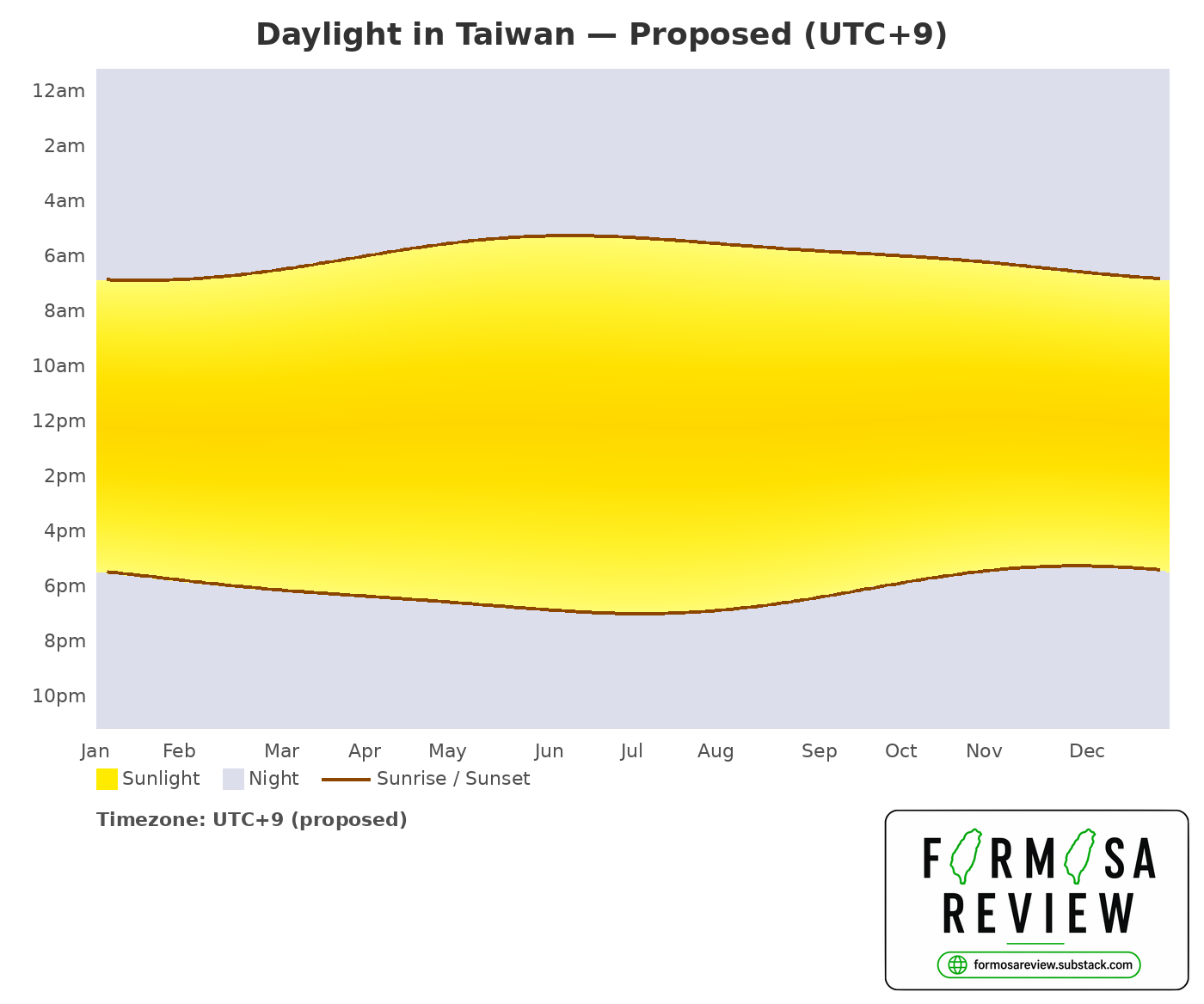
It might sound silly to claim that a tropical island is short of sunlight, but Taiwan is a country where the morning sun blasts through the curtains at ungodly hours of the morning and dips below the horizon before even the least diligent workers are clocking out. Shifting an hour later to UTC+9 would give Taiwanese people more daylight hours to enjoy, boost economic activity, make evening commutes safer, and realign Taiwan with its East Asian neighbors.
Most importantly, shifting the time zone would be an incontrovertible act of sovereignty, forcing the world to see Taiwan as having sovereign control of its own space and time.
If Taiwan wants to assert its sovereignty as a nation, as the current government asserts is a necessity, it needs to do so in ways that matter, and are felt more clearly than a quick news story about secretly visiting countries no one has heard of. In 1945, the Republic of China occupying forces imposed “Central Plains time” on Taiwan, aligning Taiwan’s time zone with central China as part of efforts to link Taiwan with China, a nation which it has never been part of.
By forcing the world’s businesses, media, communications systems, and transport authorities to recognize “Taiwan Standard Time,” the world will clearly see Taiwan’s own government is the ultimate sovereign authority over Taiwan, and China’s inability to prevent this will make it clear the two sides of the strait are not subordinate to each other.
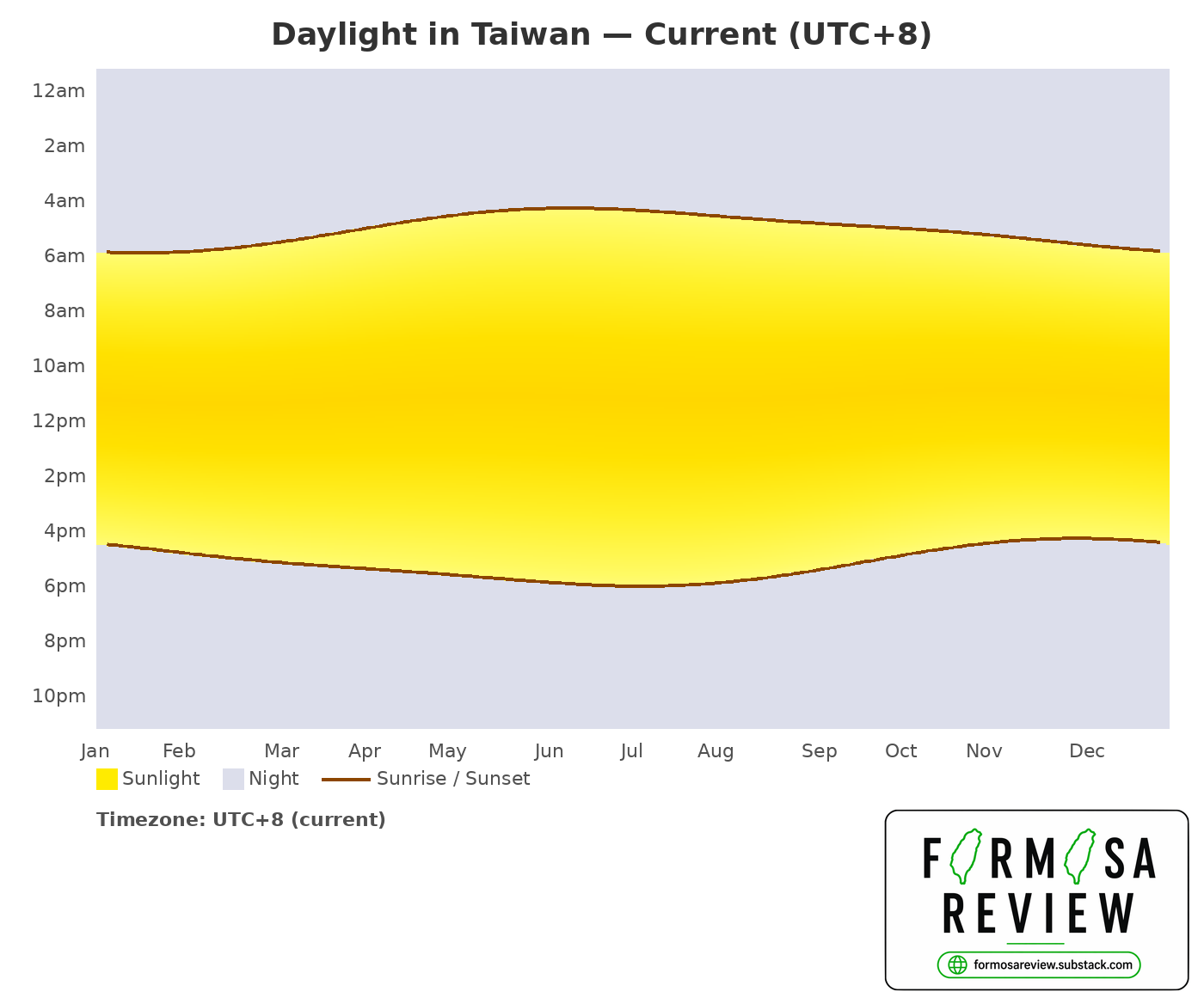
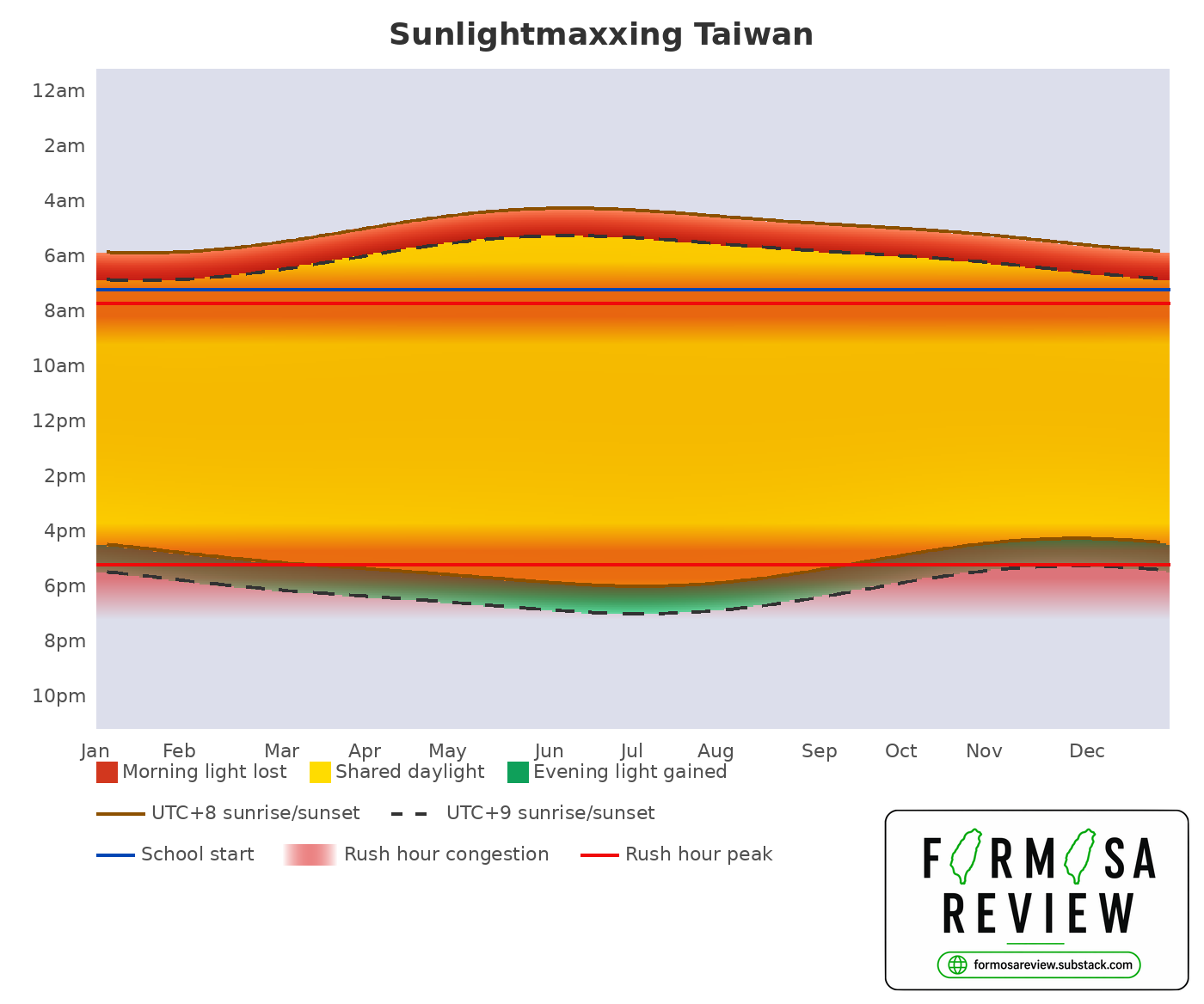
It would also make life a lot more enjoyable and safer in Taiwan. While the sun rises quite early throughout Taiwan, the Taiwanese are a nation of late-risers, the cities bustling with late-night cafés, all-night breakfast shops, and bars that close well after the morning sun has risen. Shifting forward an hour would do little to impact the rhythms of morning commutes, which generally peak in the later morning hours. With school start times at 8am and most office workers lazily making their way in around 10am, few would be commuting in darkness.
Shifting the time zone would be an incontrovertible act of sovereignty, forcing the world to see Taiwan as having sovereign control of its own space and time.
By contrast, most Taiwanese workers leave the office in darkness, around 6 or 7 in the evening, leaving little light for an outdoor stroll, jog in the park, or happy hour au plein air. The early dusk forces socializing indoors, particularly in Taiwan’s coolest months, when it is most tolerable to remain outside. Adding another hour of light to Taiwan’s evening rush hour may also have a noticeable impact on Taiwan’s atrocious traffic fatality rates.
A Brief History of Taiwan’s Time
Just as sovereignty and identity have changed throughout Taiwan’s history, so too has its time. Taiwan, as in the rest of the world, historically used local time prior to the introduction of time zones. When the Japanese took control of and unified Taiwan in 1895, Japan Standard Time (UTC +9) was briefly introduced, however the following year Western Standard Time (UTC +8) was introduced for Taiwan and the western Ryukyus (Miyako and Yaeyema islands).
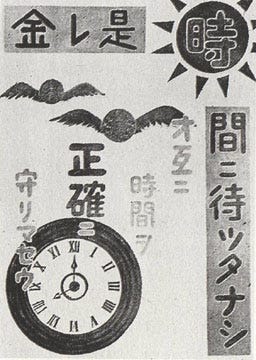
As part of a nationwide campaign of modernization in the Japanese Empire, “Time Memorial Day” (時の記念日) was established in 1920 to promote the adoption of standard time and punctuality. Introduced to Taiwan the following year, it led to the widespread adoption of standardized time (UTC+8) throughout Taiwan. This changed in 1937, when Japan abolished regional time zones and imposed Tokyo time (UTC +9) throughout the empire until the end of World War II, after which Western Standard Time (UTC +8) was restored.
The arrival of the Republic of China forces in 1945 to occupy Taiwan led to the imposition of Central Plains Time (中原標準時), also UTC+8, aligning Taiwan with Nanjing and central China. Daylight savings time was also introduced from 1945-1961, with sporadic adoption in the 1970s, largely as an energy saving measure. The enforcement of a Chinese-aligned time on Taiwan was among one of many measures imposed on the people of Taiwan to link them to China, including the imposition of Mandarin, the forced adoption of Chinese institutions and symbols, the creation of ahistorical narratives linking Taiwan to China, and the prohibition of political parties or independent media who could contest said narratives and beliefs.
The political weight of time has thus meant that Taiwan’s time zone has become inherently linked to questions of national identity as well as historical legacies of martial law and democratization, the process of which saw the uprooting and dismemberment of most authoritarian institutions, and a number of shifts to allow Taiwanese people to freely express their identity and history.
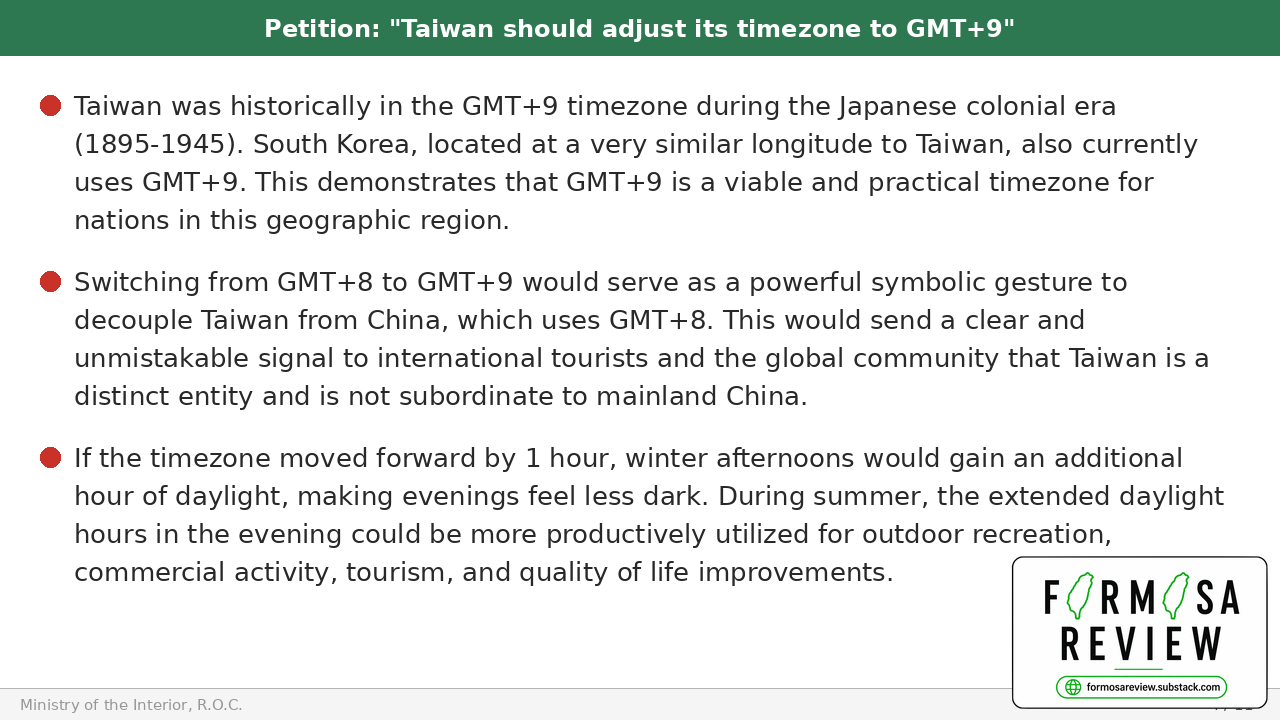
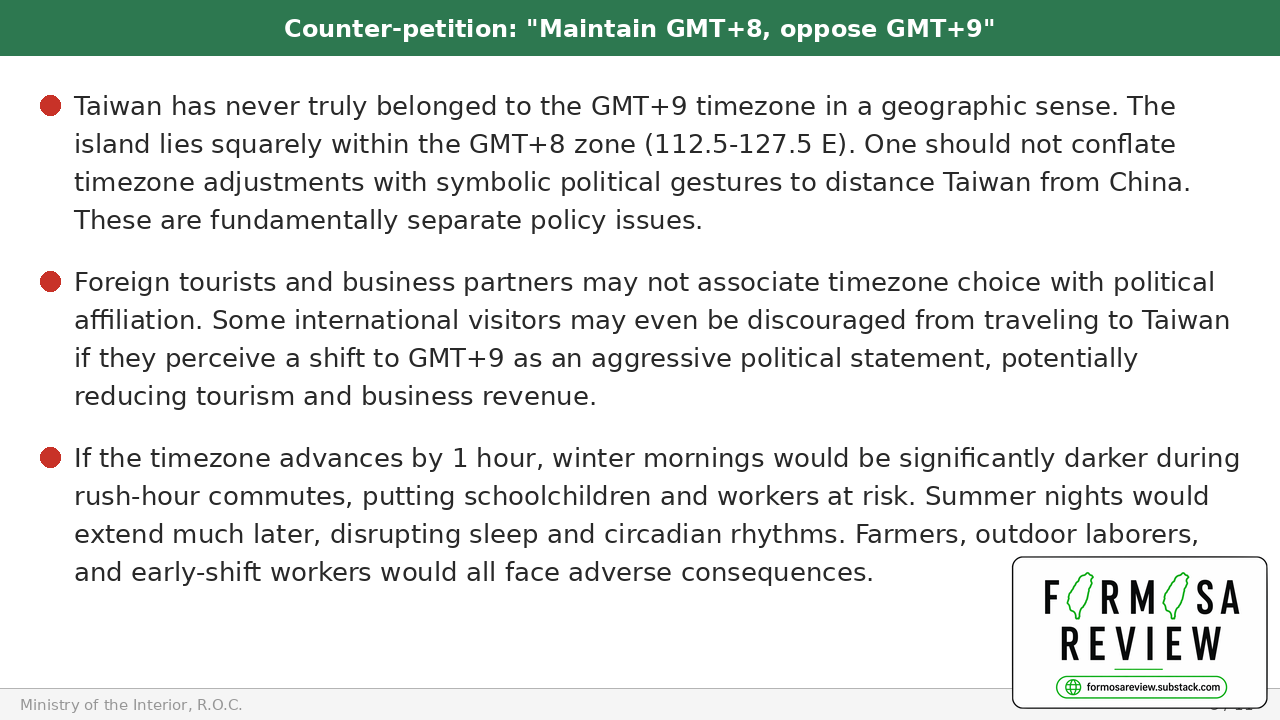
The question of Taiwan’s time zone has thus come up periodically in debates of national identity, most notably in 2017 when activists used Taiwan’s Public Policy Network Participation Platform (公共政策網路參加與批評臺) to petition the government to consider shifting back to UTC+9, aligning with Japan and away from China. Under the platform, established in 2015 to encourage public participation in policy debates, any citizen or permanent resident can petition the government to respond to a policy proposal. If it reaches 5,000 signatures within 60 days, then the relevant government agency or agencies must respond to the issue.
The petition called for changing the time zone in order to make it clear China and Taiwan are not subordinate to each other, while also ensuring winter evening rush hour would be less dark and late summer nights could be maximally enjoyed. A competing counter-petition was also launched, and both petitions quickly reached the threshold requiring a government response.
Although primarily the responsibility of the Ministry of Interior, the multi-faceted nature of time and the arguments presented necessitated the involvement of numerous other government ministries, including Foreign Affairs, Defense, Labor, Transportation, Health and Welfare, among other agencies. The Ministry of Interior organized a PowerPoint presentation summarizing the main arguments and issues of concern, excerpts of which Formosa Review has translated below.
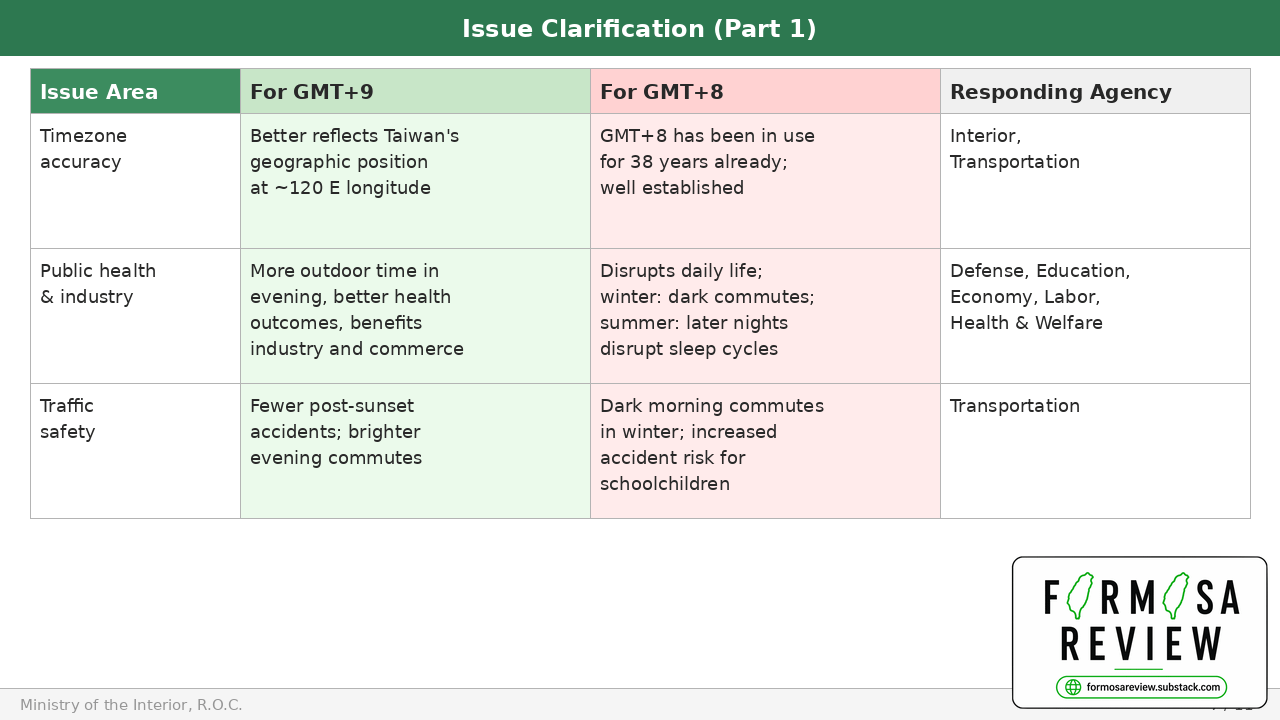
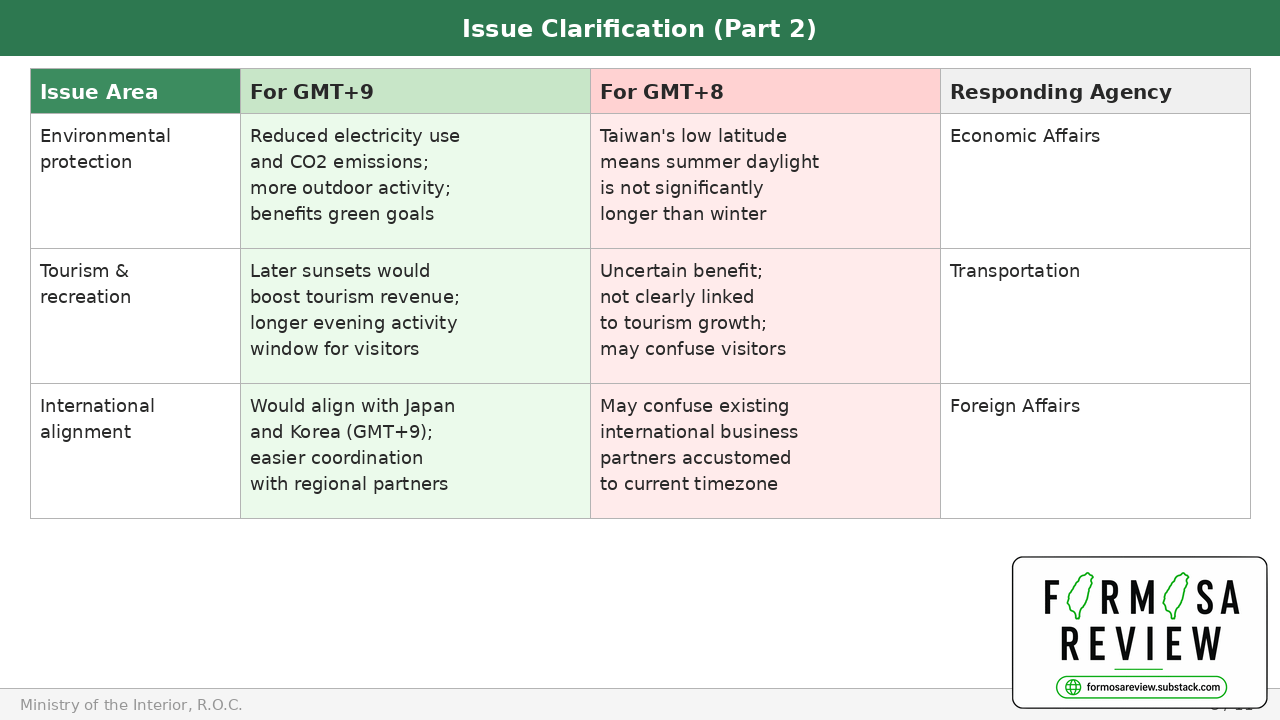
A comprehensive response was released on December 19, 2017, with responses from all the above ministries as well as Justice, Culture, and the Overseas Community Affairs Council. Participants in the interagency process convened by then-Minister without Portfolio Audrey Tang concluded that changing the time zone would not be enough to help the world understand the differences between Taiwan and China, and instead suggested other methods for establishing Taiwan’s international image. The brief report is a fascinating insight into Taiwan’s efforts at soft power promotion overseas, and may in fact mark the first and only time Taiwan has had an interagency process evaluating and assessing efforts and strategies of “marketing” Taiwan.
The report breaks down the issue into categories relevant to each government ministry, listing out existing strategies as well as proposed follow-up efforts to promote Taiwan internationally. Several of the ideas listed are excellent but have not been implemented, while others remain mainstays of Taiwan’s foreign marketing, yet have shown few results. Below I have summarized and translated (collaboratively with Claude AI) each section along with a comment reflecting on these efforts a decade later:
Attendees agreed that the government and all sectors of society should market Taiwan’s strengths abroad, highlight Taiwan’s uniqueness, and increase international visibility. Recommended approaches include marketing Taiwan’s advantages and using soft power to create differentiation, highlighting Taiwan’s characteristics to build an international image:
1. Marketing Taiwan’s Strengths
(a) Democracy and Human Rights Values
Responding agenc(ies): Ministry of Justice, Ministry of Culture
“Human rights as a national foundation” is the government’s established policy. Taiwan’s pursuit of democracy, freedom, and progressive human rights values is internationally recognized. According to the NGO Freedom House’s global freedom reports, Taiwan has been rated a “Free” country for 18 consecutive years since 1999, and in 2017, Taiwan’s total score surpassed the United States, rising to the “most free” level.
Regarding human rights protections, although Taiwan cannot participate in UN activities, it voluntarily complies with international human rights standards and works diligently to put them into practice, domesticating major international human rights conventions into national law. Of the UN’s 9 core international human rights conventions, 6 already have domestic legal effect in Taiwan. Taiwan submits national reports and invites international human rights experts to conduct reviews, helping examine the current state of human rights progress and provide recommendations for improvement—earning high praise from international human rights experts.
Regarding the Ministry of Culture’s National Human Rights Museum Preparatory Office: after the lifting of martial law, the former Jingmei Military Detention Center in Xindian and the Green Island Prison were transformed into memorial parks, bearing witness to Taiwan’s political human rights development and preserving the collective memory of that era. After years of preparation, the Preparatory Office has assembled Taiwan’s human rights and political victims’ archives and artifacts. The Legislature passed the National Human Rights Museum Organization Act on November 28, 2017. Additionally, the Legislature recently passed the Act on Promoting Transitional Justice, which provides the legal basis for transforming Chiang Kai-shek Memorial Hall. To build social consensus, the Ministry of Culture has launched a “Social Discussion Project on Chiang Kai-shek Memorial Hall Transformation.”
Follow-up plan: Continue Promoting Democracy and Human Rights
Three UN core conventions have not yet been domesticated: the Convention Against Torture, the International Convention on the Protection of the Rights of All Migrant Workers and Members of Their Families, and the International Convention for the Protection of All Persons from Enforced Disappearance. Relevant agencies are actively working on domestication. The government will continue to research relevant laws, systems, and policies, plan human rights education, cultivate and deepen human rights values, and build Taiwan’s comprehensive human rights framework to make Taiwan Asia’s leading human rights nation.
Beyond continuing to promote the collection, research, exhibition, educational outreach, and international exchange of human rights archives and artifacts from the authoritarian era, the government will also expand support for organizations practicing and promoting various human rights issues and contemporary human rights principles, demonstrating Taiwan’s determination to pursue universal democratic and human rights values.
The “Social Discussion Project on Chiang Kai-shek Memorial Hall Transformation” will proceed through information platform development, vision workshops, and citizens’ conferences, focusing discussion on why and how to transform the memorial. A draft amendment to the National Chiang Kai-shek Memorial Hall Management Office Organization Act will be prepared, followed by expanded public hearings to establish the direction of transformation.
My comment: There is no doubt that Taiwan has achieved many plaudits since democratization for its accomplishments in human rights and as Asia’s most successful democracy. This has been an effective basis for building support from sympathetic constituencies within democratic countries, particularly in Europe and the US. This message of democratic solidarity had a lot of currency under the Biden administration, yet has limited effectiveness in messaging to an America now dominated by the democracy-skeptical MAGA movement. Democracy also distinguishes Taiwan from China today, but it is not the main basis for the national split between the two countries, and does not necessarily clarify Taiwan’s sovereign independence.
The action plan from the ministries of Justice and Culture is also very domestic focused in its limited scope. Adopting UN human rights conventions may be a simple symbolic nod of Taiwan’s good intentions, but these steps gain little international attention and are irrelevant as Taiwan remains shut out of the UN for the foreseeable future.
For all of Taiwan’s accomplishments in human rights, much of its foreign policy directly contradicts Taiwanese and international values, bringing far more negative than positive attention. Beyond Taiwan’s continued use of the death penalty and lack of an asylum law, it includes Taiwan’s open embrace of the child predator king of Eswatini and its support of illegal settlements in the occupied West Bank, all of which command far more international attention and concern. This disconnect has led to criticisms that Taiwan often uses human rights as a “cultural commodity” rather than out of a genuine international commitment.
Taiwan’s domestic actions, such as opening human rights museums, while important for Taiwanese society, do little to raise international awareness. The only site of international interest mentioned in this section is the Chiang Kai-shek Memorial Hall, which is one of Taiwan’s most famous international landmarks and a major tourist attraction, yet decades later it remains untransformed and continues to glorify a Chinese dictator who murdered tens of thousands of Taiwanese. As long as Taiwan’s most famous cultural landmark remains a memorial to someone who believed both sides of the strait were One China, Taiwan will struggle to explain to international tourists that its society actually rejects this narrative.
(b) Achievements in Open Data
Responding agenc(ies): National Development Council
The National Development Council shares Taiwan’s open data implementation experience at international forums including the International Academy of CIO (IAC) and the International Council for Information and Technology in Government Administration (ICA). Taiwan’s open data ranked first in the world on the Global Open Data Index published by the UK’s Open Knowledge Foundation in both 2015 and 2016/2017.
Follow-up plan: Continue Open Data Promotion
Taiwan’s open data achievements have attracted considerable international attention. The NDC will continue sharing Taiwan’s open data experience at international venues including IAC, ICA, OGP, and IODC to raise Taiwan’s global visibility.
My comment: Taiwan’s achievements in open data are interesting to policy and technical nerds, but bring little global visibility to Taiwan. A decade later, Taiwan’s government websites remain plagued by poor and clunky user interfaces, where data tables are often presented as images, and have either no or incomplete translations into English and other foreign languages.
(c) International Cooperation Through Trade and Diplomacy
Responding agenc(ies): Ministry of Foreign Affairs
To secure Taiwan’s international visibility and recognition, the Ministry of Foreign Affairs continually strengthens the depth and breadth of international exchange and cooperation. Substantive progress has been made in trade exchange, youth working holiday programs, and visa-free or landing visa arrangements. Through participation in international organizations, Taiwan demonstrates its commitment to globally significant issues including agriculture, fisheries, food security, and climate change, raising the country’s visibility. The Ministry also assists local governments in promoting city diplomacy and helps NGOs connect internationally, operating programs such as overseas technical missions, International Youth Ambassadors, Agriculture Youth Ambassadors, and Junior Diplomats—with abundant results that have been widely praised by the international community.
Follow-up plan: Continue International Cooperation Marketing Through Trade and Diplomacy
The Ministry of Foreign Affairs will continue strengthening collaboration with government agencies at all levels, civil organizations, youth, and the business community to jointly advance comprehensive “pragmatic diplomacy.” This includes actively promoting trade exchange with countries and executing “multi-level, multi-domain, multi-faceted” cooperation programs benefiting their citizens. Taiwan will continue participating in international humanitarian relief work, exercising soft power, and fulfilling its responsibilities as a member of the international community.
My comment: The smörgåsbord nature of this response reflects the foreign ministry’s lack of a comprehensive strategy for promoting Taiwan’s international visibility. Several of the initiatives mentioned, such as elevating subnational and sister city diplomacy, have achieved progress but remain underutilized and lack a coordinated national strategy. Sister city agreements are overwhelmingly initiated and funded by local city administrations, and remain dependent on individual mayors’ plans and budgets.
It is unclear what international visibility Taiwan has achieved in agriculture, fisheries, food security, and climate change. Youth working holiday programs have brought many young people from around the world to Taiwan, but remain limited and should be expanded significantly, particularly for regional partners such as Australia.
The ministry’s follow-up plan is a series of buzzwords that lacks any strategic outlook or focus.
(d) Deepening International Organization Participation
Responding agenc(ies): Ministry of Health and Welfare
To deepen international participation, the Ministry of Health and Welfare promotes various policies, including continued participation in activities organized by international health organizations. Minister Chen led Taiwan’s WHO Action Team to Geneva during the 70th World Health Assembly, seeking bilateral meetings with countries and medical organizations. The Ministry also attended the 7th APEC High-Level Meeting on Health and the Economy, presenting on “Towards a Sustainable Health System” and introducing Taiwan’s healthcare system, national health insurance, long-term care, and smart medicine policies.
The Ministry also actively participates in international health aid programs, including the Taiwan International Healthcare Training Center, the Medical Equipment Aid Platform, the Pacific 6 Allied Nations Medical Cooperation Program, and Taiwan International Health Action (TaiwanIHA), co-established with the Ministry of Foreign Affairs in 2006. In line with the government’s New Southbound Policy, the Ministry promotes the New Southbound Medical Cooperation and Industry Chain Development Mid-to-Long-Term Plan, leveraging Taiwan’s medical soft power to deepen health networks and expand influence in New Southbound countries.
Follow-up plan: Continue Deepening International Organization Participation
Responding agenc(ies): Ministry of Health and Welfare
The MOHW will continue deepening international participation through international health organization meetings and activities, international health cooperation, health aid programs, hosting international health conferences, and New Southbound medical cooperation. The Ministry will also share international participation results on its English-language Twitter account (@MOHW_Taiwan).
My comment: Taiwan’s obsession with the World Health Assembly has for too long diverted resources that would be better spent raising Taiwan’s international visibility more broadly. Taiwan is not going to be allowed to join the WHA, and as long as it defines that as a benchmark for international participation, it will continue to lead to headlines such as this week’s “China says it won’t allow Taiwan to attend WHO’s annual assembly,” which only end up furthering the notion that China somehow has control over Taiwan’s foreign policy and international participation. The foreign and health ministries dedicate extremely large budgets and resources towards advocacy in Geneva, which is merely for a small audience of diplomats and NGOs, and has no strategy for actually getting into the WHA.
There is no doubt that Taiwan has numerous accomplishments in world health, from its world class affordable National Health Insurance to its impressive pandemic response to advances in biotech, all of which are extremely compelling stories of Taiwanese innovation and brilliance. However, these stories would be better shared with mass audiences throughout the world, rather than uninterested diplomats in Geneva. Taiwan’s exclusion from the WHA has nothing to do with its achievements in public health, and even if Taiwan had no accomplishments in this arena, it would still deserve a seat at the WHA.
When Taiwan does try to share these accomplishments publicly, it often fails to suit the message to the audience. Taiwanese diplomats often focus on the COVID-19 pandemic in messages to US audiences, where narratives about the pandemic are highly polarized, and emphasize masks and vaccines to Republican audiences largely skeptical of both measures. Meanwhile, Taiwan misses a great opportunity to open dialogue with the progressive Left in the US, many of whom still believe Taiwan is a right-wing dictatorship, by showcasing Taiwan’s achievements in universal healthcare.
Also of note: the “English language Twitter account” does not actually post in English.
(e) Gender and Marriage Equality
Responding agenc(ies): Executive Yuan Gender Equality Office, Ministry of Justice
The Executive Yuan Gender Equality Office continues to promote marriage equality. The 2017 revised Gender Equality Policy Guidelines include concrete measures encouraging all sectors of society to value gender human rights, actively promote discussion on protecting the rights of diverse genders and non-marital cohabiting partners, and study measures to promote the welfare, care, and rights protections of same-sex families.
Following the Constitutional Court’s Interpretation No. 748, published on May 24, 2017, the Executive Yuan established a Same-Sex Marriage Legal Review Task Force under then-Secretary-General Chen Mei-ling. The Gender Equality Office participates in related meetings.
Taiwan has actively engaged with human rights issues in recent years. Same-sex marriage and same-sex partner rights protections have been vigorously discussed in society and are shared concerns in the concluding observations of the first and second ICCPR/ICESCR national report reviews and the second CEDAW national report review.
Follow-up plan: Continue Promoting Gender and Marriage Equality
Responding agenc(ies): Executive Yuan Gender Equality Office, Ministry of Justice
Per Constitutional Court Interpretation No. 748, relevant agencies must complete the necessary legal revisions or new legislation within two years of the interpretation’s publication. The Executive Yuan has convened a Same-Sex Marriage Legal Review Task Force to carefully study the rights and obligations that should be afforded to same-sex marriages, guided by principles of minimizing social impact and building maximum consensus. The Executive Yuan will send a reasonable and feasible bill to the Legislature as soon as possible within the interpretation’s deadline. Continuing efforts include:
1. Advancing same-sex marriage legislation to protect same-sex family rights.
2. Increasing public understanding and acceptance of same-sex families: The Gender Equality Office will implement a 2019–2022 “Key Gender Equality Issues Project,” with “eliminating gender stereotypes and prejudice” as a priority. Working with relevant ministries and local governments, the Office will conduct publicity campaigns, lectures, solicitation programs, and media literacy events to improve public awareness and reduce prejudice.
3. The Gender Equality Office receives an average of 10–20 foreign delegations annually and participates in domestic and international gender equality conferences. The Office will incorporate same-sex marriage legislation into Taiwan’s gender equality briefings, promoting Taiwan’s stance on marriage equality to raise international visibility.
My comment: Taiwan’s advancements in marriage equality have been one of its most effective international soft power successes. LGBT rights are a particularly effective message in the West, but have diminishing returns as backlash to LGBT rights rises in the West and as marriage equality becomes more widespread in Asia. Taiwan will need to ensure it has a strong overall human rights image to avoid accusations of pinkwashing.
(f) Public Safety
Responding agenc(ies): National Police Agency, Ministry of the Interior
The American Chamber of Commerce’s 2017 Business Climate Survey ranked “Family feels very safe” as the #1 advantage of living in Taiwan, up from #3 in 2016. The #2 advantage was “Living in Taiwan is quite easy and comfortable,” and #3 was “Taiwanese people are extremely friendly.” Overall, members broadly consider Taiwan a safe and friendly work and living environment.
Numbeo’s 2017 Global City Safety Index ranked Taipei #3 worldwide with a crime index of 15.76—just behind Abu Dhabi (15.51) and Munich (15.72). Taipei ranked ahead of Singapore (#8), Tokyo (#16), and Hong Kong (#23), making it the #1 city in East Asia.
Follow-up plan: Continue Fighting Crime and Maintaining Public Safety
Responding agenc(ies): National Police Agency, Ministry of the Interior
The NPA will continue executing various concrete plans, refining crime prevention strategies, and improving effectiveness. It will continue monitoring factors that may affect domestic public safety, addressing trends in crime statistics and high-profile security situations, and timely integrating inter-agency government resources to develop and implement security policies with demonstrable results.
My comment: Taiwan is one of the safest countries, if not the safest, in the entire world. This is a narrative that directly counters the globally pervasive narrative of “the most dangerous place on earth.” Taiwan’s safety is consistently cited by foreign travelers and residents as one of Taiwan’s strongest features, and is one of the few democracies ranked among the most safe countries. Taiwan should invest significant resources in spreading narratives promoting Taiwan’s safety and high levels of societal trust.
There is an important soft power narrative for Taiwan to share as a society that has achieved extremely high public safety without resorting to authoritarianism. In focus groups on international communication held in Taiwan, I have often used the framework of safe, convenient, trust as an alternative narrative framework for branding Taiwan. It would also help for Taiwan to abandon its commitment to the death penalty, for which there is no evidence that it has any deterrent effect on crime.
2. Using Soft Power to Create Differentiation and Build an International Image
(a) Civic Participation and Open Government Results
Responding agenc(ies): Public Digital Innovation Space (PDIS)
On November 24, 2016, the Premier declared at a cabinet meeting that open government is the current government’s fundamental principle and policy goal, requiring dedicated personnel. All ministries now have designated Participation Officers (POs), forming a stable mechanism. On December 4, the Executive Yuan further issued the “Directions for Implementing Open Government Participation Officers in the Executive Yuan and Subordinate Agencies,” establishing an institutionalized framework for candid dialogue and mutual trust between government and the public.
The Executive Yuan also addresses issues of public concern that are cross-ministerial and involve multiple stakeholders. The PDIS team collaborates with relevant ministries to convene collaboration meetings with government agencies and civil stakeholders, jointly clarifying facts, aligning perspectives, and seeking viable solutions. Twenty-five such meetings have been held to date, implementing civic participation through practical case work and deepening open government principles.
Taiwan’s open government efforts have attracted considerable international attention due to their clear principles and concrete approach, particularly within the Open Government Partnership (OGP) and other international organizations and conferences. The NDC-led government data openness initiative has ranked first in international evaluations for two consecutive years. Minister Audrey Tang and other open government advocates are highly active in international participation, frequently invited to international conferences, with frequent foreign media interviews and visiting delegations—effectively highlighting Taiwan’s unique open government experience, demonstrating the value of deepened democracy, and raising international visibility.
Follow-up plan: Continue Promoting Open Government
Responding agenc(ies): PDIS
Building on the existing foundation, continue promoting open government to raise international visibility.
My comment: Per the previous discussion on open government, this has had limited reach internationally, and would require significant technical improvements in Taiwan’s government websites and information systems to have a broader reach.
(b) Packaging Taiwan’s Stories and Food Documentaries
Responding agenc(ies): Ministry of Culture
The Ministry of Culture has implemented a policy of internationalizing local culture, collaborating with diplomatic, trade, and tourism agencies to provide Taiwanese cultural materials so that all overseas government offices become soft power bases, achieving the goal of “every office is a cultural center.” In alignment with the New Southbound Policy, the Ministry invited Southeast Asian arts and culture professionals to form a Southeast Asian Advisory Committee, continues to sponsor the Taiwan Youth Cultural Gardeners program to encourage two-way exchange between Taiwanese youth arts workers and Southeast Asian cultural figures, and strengthens Taiwan’s cultural connections with Austronesian peoples. The Ministry also promotes the internationalization of Taiwan’s cultural festivals and local cultural support programs, establishing international cultural identity value for local arts and cultural activities, promoting cultural tourism and local industry prosperity. Through bringing Taiwanese contemporary art and classic works onto the international stage while incorporating diverse arts activities, it presents Taiwan’s uniquely rich local culture and shapes an overall national brand.
Follow-up plan: Continue Packaging Taiwan’s Stories and Food Documentaries
Responding agenc(ies): Ministry of Culture
Continue promoting the policy of internationalizing local culture.
My comment: Part of Taiwan’s struggle to promote “Taiwanese culture” abroad is a lack of consensus on what precisely constitutes Taiwanese culture. When the ROC claimed to be “the real China,” it took on the role of promoting traditional Chinese culture throughout the world, and many Taiwanese missions overseas still continue these traditions, often erasing Taiwan and its status altogether from the conversation.
To effectively spread Taiwanese soft power, cultural agencies would need to focus on aspects that are uniquely Taiwanese, and tell Taiwan’s own historical and political story alongside cultural development. A great example is the success of the Taiwanese novel Taiwan Travelogue, which tells the story of Taiwan under Japanese rule, and has won major attention and acclaim overseas, with little government support for its translation and promotion. Increasing funding for translating Taiwanese literature and adapting Taiwanese works for television and film would be critical not only for increasing Taiwan’s soft power overseas, but stimulating domestic cultural fields.
(c) Refined Tourism and Establishing Taiwan’s Culinary Identity
Responding agenc(ies): Ministry of Transportation and Communications
To align with international trends of tourism localization, digitalization, and sustainable development, the Tourism Bureau is actively promoting “Tourism 2020—Taiwan Sustainable Tourism Development Strategy.” Through five strategies—diversifying markets, stimulating domestic travel, guiding industry transformation, developing smart tourism, and promoting experiential tourism—along with multiple policy programs, the Bureau actively builds Taiwan’s tourism image around diversity, refinement, and quality, encompassing food, culture, wellness, romance, and ecology. Combined with the 2017–2020 annual tourism themes of ecology, bays, small towns, and mountain spine trails, the approach returns to the essence of “the more local, the more international,” enhancing Taiwan’s tourism sophistication and local character, with the aim of establishing Taiwan as a “friendly, smart, experiential” premier Asian travel destination.
Follow-up plan: Continue Refined Tourism and Culinary Identity
Responding agenc(ies): Ministry of Transportation and Communications
1. The Tourism Bureau will continue to follow the Tourism 2020 strategy, moving toward sustainable development goals, slowing down to rethink and uncover more of Taiwan’s tourism uniqueness and differentiation.
2. Continue integrating the sustainable philosophy of “eat local, eat seasonal” and respecting food miles, building Taiwan’s food brand image and culinary culture through local food arts, ingredients, tableware, food education, dining companions, and food tourism. This includes regionalized local food tourism routes and expanded community participation.
3. Partner with Michelin to publish the Taipei Michelin Guide, elevating Taiwan’s overall culinary brand to international standards and establishing Taiwan’s culinary identity for the world to see.
My comment: Tourism and culinary identity have been two areas of strong improvement for Taiwan’s overseas soft power. Since 2017, Taiwan has effectively pivoted away from Chinese tourism towards diversified tourism flows from Southeast Asia and Western countries, buoyed at times by effective outreach such as Taiwan’s halal tourism campaign. Taiwan is an incredibly compelling country whose ordinary people are its most effective ambassadors, I don’t know of anyone who has visited Taiwan and not had an extremely positive experience, making international tourism an effective soft power strategy.
Of course, this can turn counterproductive when tourists arrive on “China Airlines” or book tickets to “Taipei, China,” giving travelers the false impression that Taiwan is part of China. Taiwan should not allow any foreign carrier to fly to Taiwan that lists Taiwan as part of China, or allow any foreign hotel to operate that lists Taiwanese cities as being in “China.”
The development of Taiwanese culinary identity has also been a very successful global phenomenon, but more due to the efforts of Taiwanese and diaspora Taiwanese chefs, critics, and food vendors than government intervention. Taiwanese food is now an established category in major international restaurant review categories, with Taiwanese restaurants reaching international acclaim. Writers such as Clarissa Wei have brought Taiwanese cooking into the English language world through cookbooks, and overseas Taiwanese specialty stores such as Brooklyn-based YunHai have used dried fruit to tell the story of China’s pressure against Taiwan (founder Lisa Cheng Smith also writes a popular Substack).
These efforts have all happened with no government support. The pervasiveness of bubble tea has done little to raise awareness of Taiwan’s unique identity, and most Taiwanese restaurants abroad lack the resources or support needed to effectively build Taiwan’s brand. There is a proven model pioneered by Thailand’s Global Thai gastro-diplomacy initiative which Taiwan should adopt.
(d) Cultivating Internationally Competitive Artists
Responding agenc(ies): Ministry of Culture
To support performing arts groups classified at the “excellence” tier in tiered arts group subsidies, the Ministry of Culture promotes the Taiwan Brand Team program to build Taiwanese ensemble brands, cultivate cultural capital, shape Taiwan’s cultural image, promote international exchange, and conduct tours of remote and outlying island areas to develop audiences and arts appreciation. In 2017, the program supported five groups to perform on international stages: Cloud Gate Culture and Arts Foundation, Ju Percussion Group Foundation, Paper Windmill Theatre, U-Theatre Culture and Arts Foundation, and Ming Hwa Yuan Arts.
Follow-up plan: Continue Cultivating International Artists
Responding agenc(ies): Ministry of Culture
Continue the Taiwan Brand Team program so performing arts groups can shine on the international stage and serve as Taiwan’s cultural calling cards to the world.
My comment: As discussed in section B, Taiwan needs to focus on identifying and promoting uniquely Taiwanese cultural aspects, and direct state funds towards cultural and artistic development. Although many such state subsidies exist, budgets are shrinking and Taiwanese artists often complain state funding comes with too much control and favor for-profit entities over individual artists.
(e) Strengthening the Sports Environment
Responding agenc(ies): Ministry of Education
To achieve the goal of athletes shining on the international stage and reaching the pinnacle of competitive sports, the Ministry of Education will create a quality sports environment. Competitive sports programs will incorporate five core elements: “Select” (scientific talent identification), “Train” (structured training systems), “Compete” (international competition participation), “Support” (athlete counseling), and “Reward” (incentive measures). The Ministry will also guide nationally representative sports federations toward healthy organizational operations to effectively enhance Taiwan’s competitive sports capabilities, achieve new heights in competitive excellence, and earn national glory at international multi-sport events.
Follow-up plan: Continue Strengthening Sports
Responding agenc(ies): Ministry of Education
1. Implement integrated scientific talent selection strategies, expand medal-winning advantages, build a four-tier athlete capability database, establish a scientific selection platform, and conduct long-term tracking and development of successor teams.
2. Strengthen the effectiveness of sports talent development to build international competitive strength.
3. Establish tiered international competition participation and support teams.
4. Implement comprehensive career counseling mechanisms for athletes and coaches.
5. Improve reward systems for outstanding sports talent.
6. Implement the four key reforms under the revised National Sports Act, guiding nationally representative sports federations toward organizational openness, financial transparency, professional operations, and public accountability.
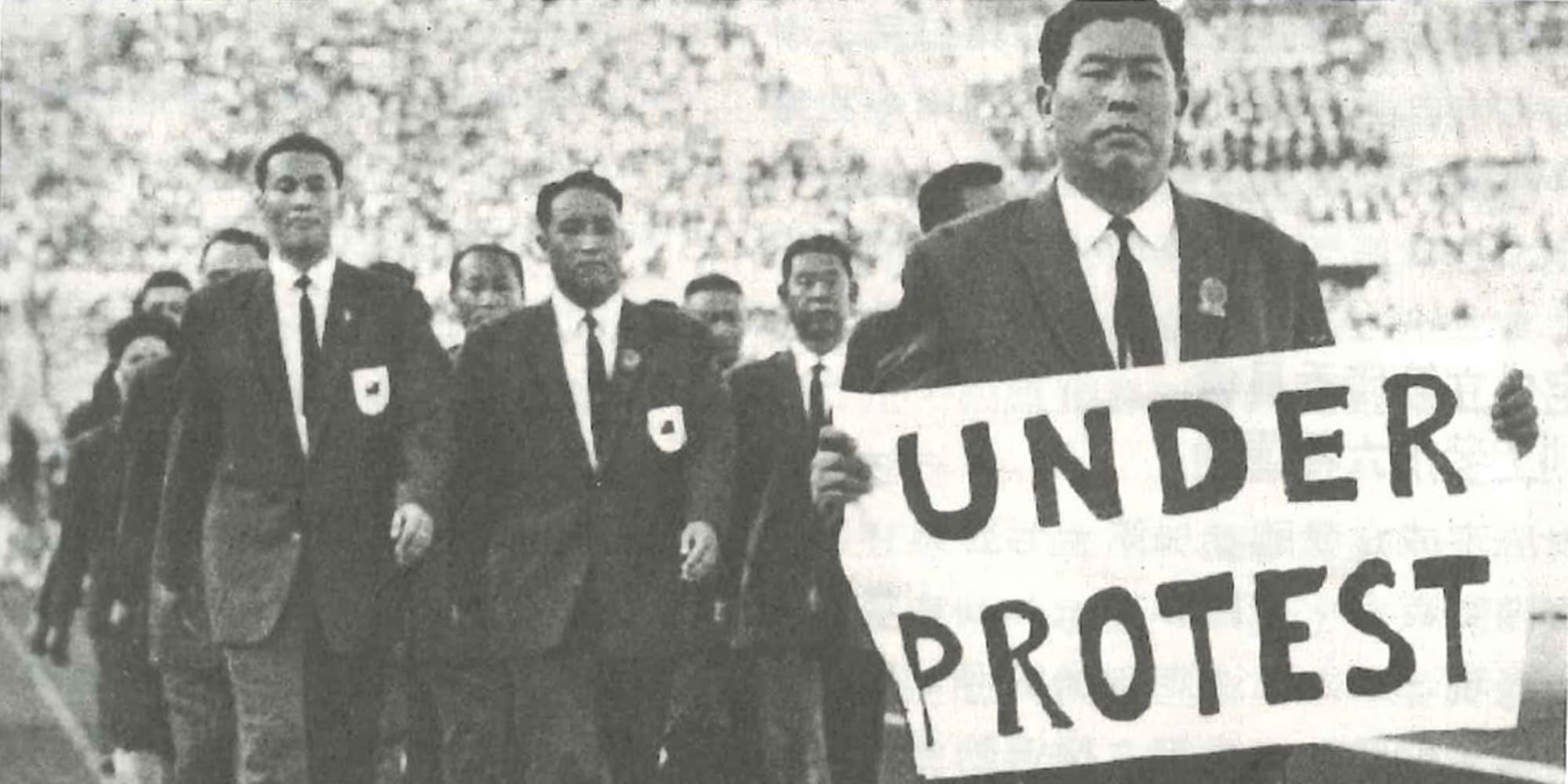
My comment: The single most important soft power action Taiwan needs to take in the world of sport is fighting the nonsense of Chinese Taipei. For most people around the world, this is the only image they have of Taiwan, and the nonsensical and insulting label is one of China’s most effective cognitive warfare efforts against Taiwan. Taiwanese athletes must take the lead where their government has not, protesting as the KMT used to do, in order to challenge the discriminatory label.
(f) Establishing the Made-in-Taiwan (MIT) Brand
Responding agenc(ies): Ministry of Economic Affairs
The Industrial Development Bureau promotes the MIT Smile Product Certification System (since 2010) to help traditional industries improve product quality, establishing a “safe, healthy, and trustworthy” image for Taiwan-made products and assisting with domestic and international market expansion.
Category 1 (Enhanced Guidance Industries) now covers 17 categories and 22 product types: apparel, underwear, knitwear, swimwear, towels, bedding, hosiery, footwear, bags/luggage, home appliances, stone, ceramics, wood/bamboo products, pesticides, environmental chemicals, veterinary pharmaceuticals, textile hats, scarves, textile gloves, umbrellas, textile protective gear, and fabric curtains. Category 2 has adopted cosmetics GMP and the CNS Mark certification systems. Category 3 (general products) now includes IT products, toys, audio-visual equipment, lighting fixtures, sunglasses, and more, and is accepting certification applications.
Follow-up plan: Continue Building the MIT Brand
Responding agenc(ies): Ministry of Economic Affairs
The Ministry of Economic Affairs will continue expanding the MIT certification program.
My comment: When I first moved to Taiwan, I thought all the products advertising “MIT” were advertising that they had been engineered by graduates of the Massachusetts Institute of Technology. “Made in Taiwan” is never going to be how anyone outside of Taiwan interprets “MIT.” Taiwan should instead build on the “Taiwan Excellence” brand established by the Ministry of Economic Affairs more than 30 years ago.
3. Marketing Methods
In addition to proactive efforts by each responsible agency, attendees suggested the following additional approaches:
(a) Airport Arrival Marketing
Responding agenc(ies): Ministry of Transportation and Communications
In coordination with the Tourism Bureau’s various tourism promotion activities, airports will provide locations along passenger arrival and departure routes for setting up promotional signage, lightboxes, and brochure racks. Requests will be processed according to regulations, with assistance provided.
My comment: Taiwan has the world’s best airport, with major international connections, and incredible airlines, which should be commended. However, Taiwan completely fails to market itself to transit passengers through stopover visits, a strategy that has proved extremely effective in countries such as Iceland. This is a hugely missed opportunity for an airport where more than one fifth of passengers are transiting elsewhere. It is almost impossible to book a stopover fare on Taiwan’s airlines, which also have extremely clumsy and outdated websites. The Tourism Bureau instead focuses on confusing and silly promotions such as “lucky draws” which offer visitors a chance to win a very small prize through a convoluted process, with information often available only in Mandarin Chinese. Those funds would be better spent subsidizing stopover hotels or transportation incentives to get passengers out of Taoyuan.
(b) Overseas Diaspora Outreach
Responding agenc(ies): Overseas Community Affairs Council
To help the international community learn about Taiwan’s image and values through the overseas affairs platform, key initiatives include: supporting diaspora-organized events such as “Taiwan Culture Day,” “Taiwan Carnival,” and “Taiwan Heritage Week”; encouraging overseas Taiwanese business groups to collaborate with domestic businesses to promote high-quality Taiwan products in international markets; dispatching master chefs and culinary experts to perform and teach overseas, helping overseas Chinese communities promote Taiwan’s culinary excellence; encouraging diaspora groups to promote Taiwan’s international medical services; and facilitating outreach by overseas Taiwanese to host-country political and economic leaders and mainstream media to advocate for Taiwan.
Follow-up Actions
Taiwan possesses democracy, diverse culture, and an active civil society. The government will leverage existing soft power to highlight Taiwan’s characteristics through different dimensions, making the most of its inherent advantages to strengthen differentiation from other countries. For marketing existing policy achievements, diverse and creative approaches will be adopted—for example, attendees proposed drama-based marketing to increase international visibility and recognition.
The Overseas Community Affairs Council will continue using the dense network of overseas diaspora communities and organizations as a channel for international marketing and advocacy. It will continue developing overseas Chinese education to demonstrate Taiwan’s cultural soft power, dispatch Taiwanese arts groups overseas through cross-ministerial cooperation to promote Taiwan’s diverse culture, strengthen services for overseas Taiwanese businesses, encourage overseas business communities to establish partnerships with host countries as channels for international exchange, and build a government-diaspora platform to promote Taiwan’s highlights and advantages to the world.
My comment: Taiwan’s diaspora is one of its most important global assets. Taiwanese diaspora, particularly in the US and Japan, were critical to the survival and success of Taiwan’s democracy movement, and have been a key lobbying and fundraising source for supporting Taiwan and Taiwanese political movements. However, despite the size and wealth of Taiwan’s diaspora, particularly in the United States, the diaspora remains underutilized due to several factors, including a lack of strategic direction post-democratization, political division, and the government’s focus on developing “Chinese culture” among the diaspora. The latter effort is a legacy of institutions set up by the KMT during martial law, which included many effective soft power initiatives such as the famous “love boat” program for overseas Chinese and Taiwanese youth. These programs should be reinvigorated and given a more activist nature to effectively mobilize diaspora overseas.
Support should be expanded for popular activities organized by overseas Taiwanese, including New York’s very popular “Passport to Taiwan” festival and Taiwan Fes in Tokyo. New festivals based on these successful models should be funded in Australia and the Philippines, two countries critical to Taiwan’s national security and with large Taiwanese diasporas. These sorts of festivals should be initiated in as many cities as possible, and should be expanded to include targeted information about Taiwan’s history and status in addition to just food and culture.
Time for a Change
The most important message Taiwan needs to get across overseas, regardless of what form and to what audience, is that Taiwan currently exists as a sovereign state. The above strategies and messages are all ways of drawing attention to Taiwan and creating opportunities to share effective messages letting the world know that Taiwan is not part of China and exercises its own sovereignty.
Changing the time zone is an incontrovertible way to assert that truth. Fortunately, it is also a decision that will improve ordinary people’s lives in Taiwan, and strengthen Taiwan’s connections with Japan and South Korea.
It is also a measure that can be done relatively easily, despite Taiwan’s gridlocked politics. The Executive Yuan has historically adjusted Taiwan’s time zone through annual decisions whether or not to adopt daylight savings time, and can simply issue a decision promulgating the new standard time.
President Lai has stated it is important Taiwan take measures to assert its sovereignty. Rather than embarrassing state visits to corrupt monarchies no one has heard of, changing Taiwan’s official time is a far more effective and productive assertion of state sovereignty.
Taiwan has sovereignty not only over territory, but time itself. It’s time for a change.